
Twenty-eight years ago today, a Boeing 747 exploded after takeoff from New York’s John F. Kennedy Airport, killing everyone on board. Like the 737 Max families who would find themselves living through a similar tragedy two decades later, nothing would ever be the same.
That was true for me as well. I was a correspondent for CNN assigned to report on the loss of TWA Flight 800, a half-filled flight carrying travelers to Paris at the height of the summer travel season. My immersion in the world of air accident investigations changed the direction of my life. But there is one entity for which the tragedy does not seem to have caused any significant course correction and that entity is Boeing.
When the flight to Paris, came apart in a fiery blast emanating from the plane’s center fuel tank, investigators, scientists and engineers set out on a years-long search to find out what happened. What they discovered has a startling parallel to the 737 Max disasters and a number of disasters and near-disasters in between.

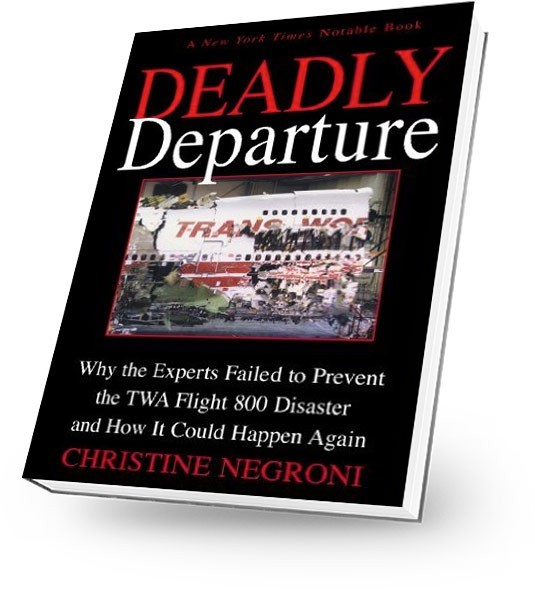
The Boeing 747 was designed with a fatal flaw. During normal flights, the jumbo jet’s large fuel tank located between the wings and below the seats of dozens of passengers, would get hot. It got so hot in fact, it could be in an explosive state 30 percent of the time. It wasn’t just the 747 that was at risk. The baked-in hazard was present on 8-thousand Boeing jets. I reported this in my book, Deadly Departure.

As it does, Boeing disputed each emerging discovery in the Flight 800 investigation, effectively slowing progress so it took 10 years for the Department of Transportation to issue rules to address the problem and another 10 years for the fixes to start being made. What I did not know then but will share with you now, is that even as the Boeing spin machine was arguing with the increasingly obvious conclusions, the planemaker was working just as hard to cover up an entirely different hazard on its latest Boeing 737. No, not the notorious 737 Max, but its forebearer, the 737 NG.
Trust me when I tell you that what Boeing got away with, both its explosive fuel tanks and substandard NG manufacturing and assembly practices made what would happen to the flawed 737 Max, if not predictable, at least not surprising.

In 1997, less than a year after TWA 800 crashed, Boeing made a big announcement; its newest iteration of the 737, the “Next Generation” or NG, had successfully flown at 41-thousand feet, “flying higher than any 737 in history” the press release touted.
And because the NG would fly higher, faster and more fuel efficiently than the earlier models, it would embrace everything that new digital technology had to offer. The planemaker told the Federal Aviation Administration it would build its new jet using computer-aided design and computer-controlled manufacturing machines.
But for years, it broke that promise, according to a team of Boeing auditors who reported in detail what they saw during repeated visits to the subcontractor making safety-critical parts.
AF Ducommun, a California-based manufacturing company would ship these completed parts to Boeing’s assembly plant in Wichita, Kansas. (“Wait”, you are saying, “isn’t the Wichita plant owned by Spirit Aerosystems?” Good on you. It is presently owned by Spirit Aerosystems but at the time, it was owned by Boeing. And yes, it is likely to soon be owned again by Boeing. Try to keep up.)
These Ducommun parts weren’t identical as they should have been, nor did they fit into position precisely as they should have. If you’ve ever had a go at self-assembly furniture, this is the experience Boeing’s workers were having as they tried to put together the modern marvel on which you and your loved ones would travel.
“I got called into a meeting and we got hammered by these frustrated manufacturing managers and employees,” said Gigi Prewitt, an assembly materials manager at the factory then. “They were so frustrated,” she said of assemblers. She was one of 10 Boeing workers assigned to audit AF Ducommun. What they found was disturbing.

Ducommon was violating dozens of procedures. “The parts have to be made per engineering design,” Prewitt told me in an interview for my upcoming book on Boeing. “They have to be made in a specific process. There is a manufacturing production certificate that matches with the type design and they were violating it.”
If you think that documenting all this in memos and meetings resulted in a course change, you would be wrong. Even though Prewitt in her innocence insisted, “It is a felony to deviate from FAA requirements. If you are involved in anything that deviates you will be prosecuted and will spend time in jail. I took it seriously but up the line, they didn’t.”
Prewitt and two others who participated in the audit, reported their findings to Boeing and were disappointed that little changed. Well, that’s not exactly correct. Things changed, but not the way the auditors expected.
Give Boeing credit for creativity. It confronted the supplier and demanded lower prices, call it discounts for defects. Ducommon kept right on working for the company.
And the parts already produced that did not conform to the manufacturing certificate? Most stayed right where they had been put, in the fuselages of NG airplanes that were delivered to airlines around the world.

The 737 NG manufacturing scandal was going on around the time the National Transportation Safety Board was concluding its investigation into the design flaw on the Boeing center fuel tanks. And that’s not all. Boeing was busy working with the NTSB on a different airplane problem.

In 1991 and again in 1994, two 737 “Classics” (the original sixties-era design) crashed killing all aboard. What caused the planes to become uncontrollable and dive into the ground was a mystery. Shortly after the crash of TWA 800, investigators finally determined that at certain speeds, pilots could not control the airplane if the rudder jammed at an acute angle.
A 1999 story by Pulitzer Prize-winning journalist Bryon Acohido, explained that “Boeing’s understanding of the air-speed control of ailerons was incorrect from the time the jet was certified by the FAA 30 years ago.” (Emphasis mine.)
That miscalculation of hazards is a recurring theme going back to the sixties with the design of the 737 and 747s and continuing today with Boeing’s recalcitrant 737 Max and 787 Dreamliner.

Both of those new airliners have been subjected to extensive safety groundings. I’d tell you why but the list of troublesome components is just too long.
When Boeing was called before the U.S. Senate in April and again June, to answer questions about its many misrepresentations, including the felony fraud charge it now faces in the Max disasters, lawmakers prefaced their criticism by telling CEO Doug Calhoun how very much they want Boeing to succeed.

“Too big to fail” is often used to describe the company. But on the anniversary of a long-ago crash, we must remember Boeing is as big as it is because it is more successful at manufacturing an image than it is at manufacturing safe airplanes.



“Discounts for defects.” Love it. I fondly recall GM manufacturing and producing “validation” cars on the assembly line where less than 2/3 of the parts had been quality validated. Unacceptable. Credit our VP at the time, Jerry Elson. He said, “Stop the line. I’ll take the hit. We will find the problems and fix them before restarting.” Most of this problems were sub suppliers not building to spec or using the wrong materials. I learned a lot in the airline business, including from Flight 800. But I owe my manufacturing quality skepticism to Jerry and the amazing folks at GMVO.